Complete Guide for Condos & Townhomes in California (2026)
📞 Get a Fast & Professional Termite Inspection Today
Same-Day Inspection Available • Licensed & Insured • HOA Specialists
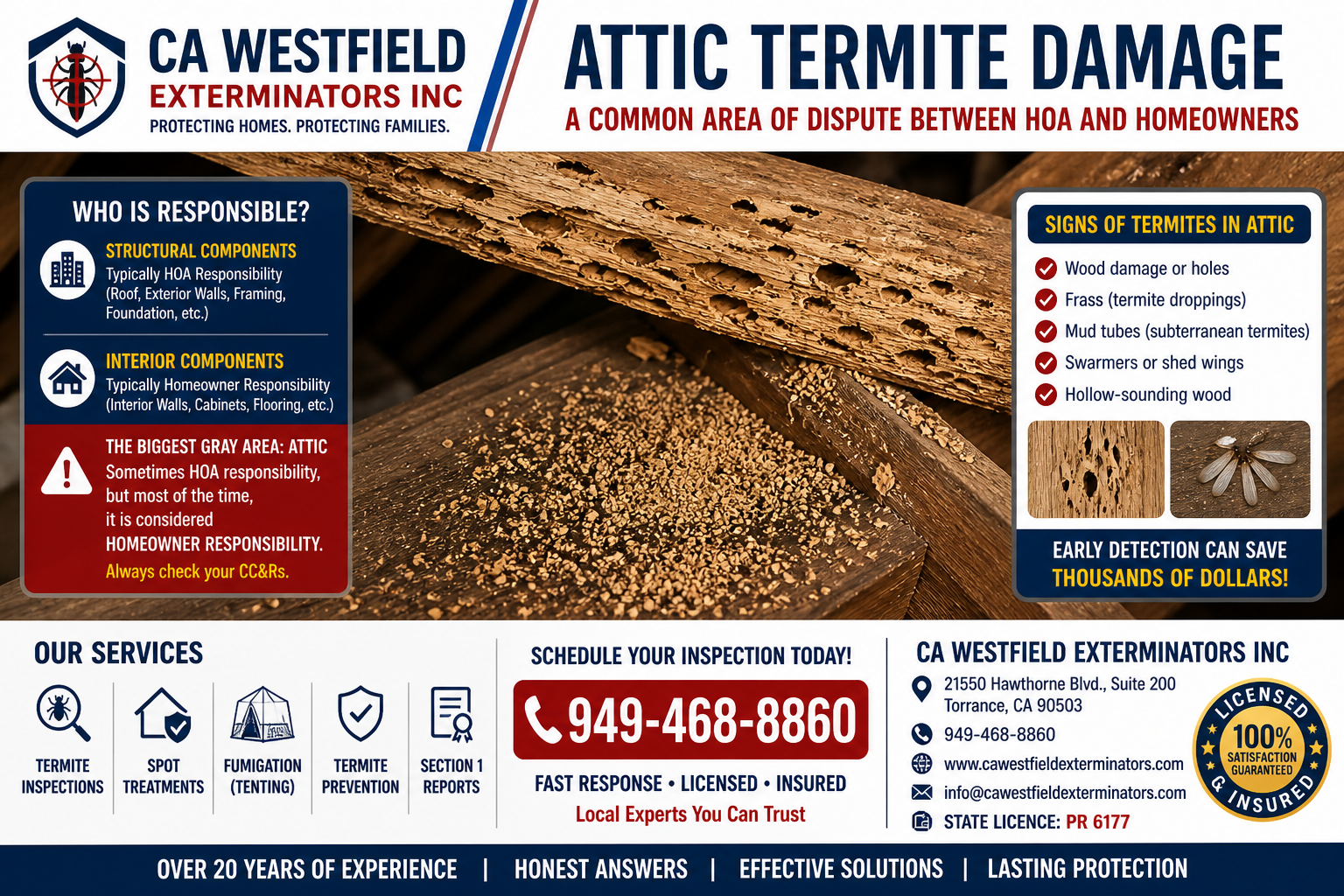
🏡 Who Is Responsible for Termite Treatment?
One of the most confusing and costly questions homeowners face is:
“Does the HOA cover termite damage, or do I have to pay for it?”
Here’s the simplified rule:
👉 Structural components = HOA responsibility
👉 Interior components = Homeowner responsibility
⚠️ But in real HOA properties, this is not always clear—and mistakes can cost thousands of dollars.
🔍 Structural vs Interior Responsibility
✔ HOA Responsibility
- Exterior walls
- Roof
- Foundation
- Structural framing
- Shared components
👉 Anything affecting the building structure
✔ Homeowner Responsibility
- Interior walls
- Cabinets
- Flooring
- Doors and trim
- Interior upgrades
👉 Anything inside your unit
⚠️ The Biggest Gray Area: Attic


Typical termite damage found in attic structures where responsibility is often disputed
The attic is where most disputes happen.
- Sometimes it falls under HOA responsibility
- But most of the time, it is considered homeowner responsibility
📌 Important:
👉 Always verify your CC&Rs before making any decision
🐜 Real Case: Eric’s Situation
- Termites found in attic
- HOA denied responsibility
- Eric proceeded with spot treatment
- Later found HOA partially responsible
👉 Result:
- Partial reimbursement
- Infestation continued
- Total cost increased
💡 Lesson:
Acting without confirming responsibility can cost you more in the long run.
⚠️ Critical Industry Insight
In most HOA communities, you cannot fumigate a single unit.
Why?
- Units are connected
- Termites travel through shared structures
- Full elimination requires multi-unit coordination
👉 Reality:
- Many homeowners choose spot treatment
- But this often leads to recurring infestations
⚠️ Important Exception: Detached Townhomes
👉 If your townhome is fully detached:
- You may be able to fumigate individually
- Treatment can be more effective
📌 However:
👉 HOA approval is still required in most cases
🏗️ When HOA Covers Termites
HOA typically covers:
- Structural damage
- Multi-unit infestation
- Common areas
❌ When HOA Does NOT Cover
- Interior damage
- Cosmetic damage
- Preventive treatment
- Single-unit infestations
🧠 Expert Recommendations (Critical)
1️⃣ Always Get a Section 1 Report
This determines responsibility and protects you legally.
2️⃣ Never Start Treatment Without HOA Approval
Especially for:
- Spot treatment
- Work affecting shared structures
👉 Risk:
- No reimbursement
- Legal issues
3️⃣ Think Beyond Your Unit
👉 If you treat only your unit:
- Termites can come back
- Cost increases over time
📞 Stop Termite Damage Before It Gets Worse
🚨 Most Costly Mistakes Homeowners Make
❌ Assuming HOA will cover everything
❌ Waiting too long
❌ Skipping inspection
❌ Not checking attic responsibility
📊 Quick Action Checklist
✔ Do you see termite signs?
✔ Do you know where they are located?
✔ Did you review HOA documents?
✔ Did you get a professional inspection?
❓ Frequently Asked Questions (Expanded)
Q1. What if HOA refuses responsibility?
👉 You may still recover costs—but only with proper documentation.
Q2. Can termites spread from neighbors?
👉 Yes. Very common in HOA properties.
Q3. Can I do spot treatment without HOA?
👉 Not recommended. You risk losing reimbursement.
Q4. Why do termites come back?
👉 Because the source is often outside your unit.
Q5. When is fumigation necessary?
👉 When infestation is widespread or structural.
Q6. Are detached units different?
👉 Yes, they may allow individual treatment.
Q7. What are the signs of termites?
👉 Droppings, holes, swarmers, wood damage.
Q8. What is a Section 1 report?
👉 A required report for active infestation and repairs.
Q9. How much does treatment cost?
👉 Spot = lower cost
👉 Fumigation = more complete solution
Q10. What happens if I delay?
👉 Damage spreads → cost increases → HOA issues
Q11. Can HOA force treatment?
👉 Yes, in multi-unit infestations.
Q12. Does insurance cover termite damage?
👉 Usually no.
Q13. Who pays during escrow?
👉 Typically the seller.
Q14. How often should I inspect?
👉 At least once a year.
Q15. What is the biggest mistake?
👉 Acting before confirming responsibility.
📞 Need a Professional Termite Inspection?
💡 Final Expert Conclusion
- HOA responsibility is complex and not always clear
- The attic is the most common dispute area
- Spot treatment alone may not fully resolve infestations
👉 The key to minimizing cost and damage:
Early detection + correct responsibility identification + HOA coordination

Related Articles:
– Termite Inspection Guide https://cawestfieldtermite.com/how-to-tell-if-you-have-termites-at-home-7-clear-signs-you-shouldnt-ignore/
– Termite Treatment Cost https://cawestfieldtermite.com/termite-inspection-cost/
– HOA Responsibility Guide https://cawestfieldtermite.com/who-pays-for-termite-damage-in-hoa-california-2026-guide/