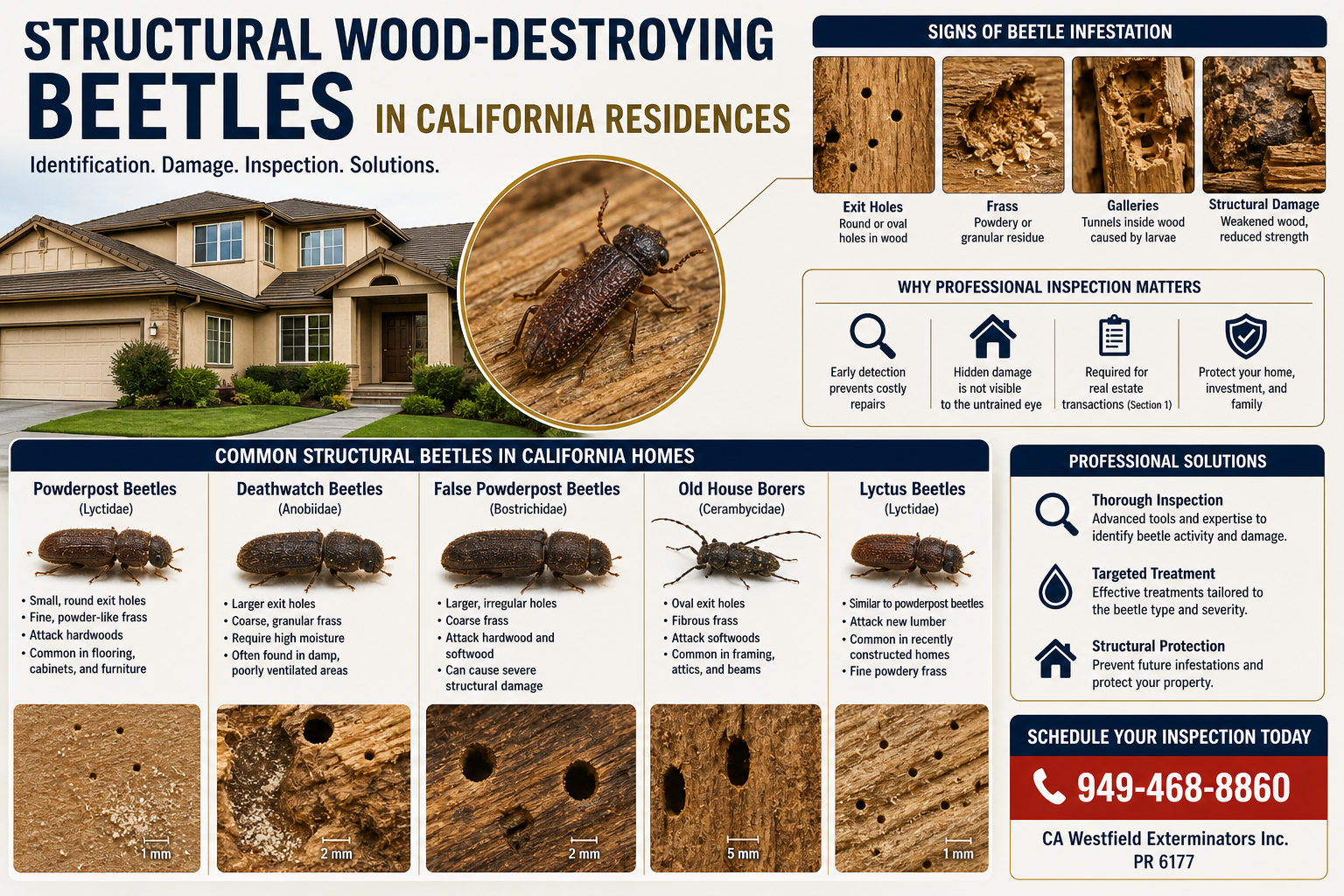
Advanced Field Guide to Identification, Damage Mechanisms, and Treatment Protocols (2026)
📞 Schedule a Certified WDO Inspection
📞 Call Now: 949-468-8860CA Westfield Exterminators Inc • Structural Pest Control License: PR 6177
WDO (Wood-Destroying Organism) Inspections • HOA • Escrow/Section 1 Specialists
🏡 Technical Overview (WDO Context)
In California, wood-destroying beetles are classified under WDO (Wood-Destroying Organisms) alongside termites and fungi.
Unlike termites, beetle infestations typically exhibit:
- Subsurface larval feeding within wood members
- Delayed external visibility (often years post-infestation)
- Material-specific targeting (hardwood vs softwood selectivity)
Field Insight:
Visible exit holes indicate post-development emergence, meaning the structural compromise has already occurred.
🔬 Taxonomic Groups of Structural Beetles
Primary families encountered in structural pest control:
- Lyctidae → True Powderpost Beetles
- Anobiidae → Deathwatch Beetles
- Bostrichidae → False Powderpost Beetles
- Cerambycidae → Longhorn Beetles (Old House Borers)
🪲 Lyctidae (True Powderpost Beetles)
Primary Hardwood Degradation Agent


🔍 Diagnostic Characteristics
- Exit holes: 0.8–1.6 mm diameter (pin-sized)
- Frass: fine, flour-like consistency
- Infestation cycle: recurrent (reinfestation-capable)
🧱 Substrate Preference
- Hardwood species with high starch content
- Flooring, cabinetry, millwork
⚠️ Structural Implication
- Progressive density loss in hardwood elements
- Often mistaken for termite activity
🪲 Anobiidae (Deathwatch Beetles)
Moisture-Dependent Structural Degradation


🔍 Diagnostic Characteristics
- Irregular exit holes (larger than Lyctidae)
- Frass: granular/pelletized
- Audible tapping (mating signal)
🌡️ Environmental Requirement
- Wood moisture content >13–15%
- Poor ventilation (crawlspace/attic zones)
⚠️ Structural Implication
- Load-bearing member weakening
- Frequently coexists with fungal decay (brown rot)
🪲 Bostrichidae (False Powderpost Beetles)
Deep-Penetration Borers


🔍 Diagnostic Characteristics
- Larger, ragged exit holes
- Frass: coarse, tightly packed
⚠️ Structural Implication
- Extensive internal gallery systems
- Late-stage detection common
🪲 Cerambycidae (Old House Borers)
Softwood Structural Frame Risk


🔍 Diagnostic Characteristics
- Oval exit holes
- Fibrous frass texture
🧱 Target Zones
- Softwood framing (pine)
- Roof/attic structural members
⚠️ Structural Implication
- Long larval cycle (years)
- Progressive loss of load capacity
🚨 Field Identification Indicators
✔ Visual Indicators
- Exit hole geometry (size/shape critical)
- Frass composition (powder vs granular)
✔ Mechanical Indicators
- Reduced wood density
- Hollow response under probing
✔ Environmental Indicators
- Elevated humidity
- Ventilation deficiencies
📞 Immediate Inspection Recommended for Any Indicators
📞 Call Now: 949-468-8860
🔬 Inspection Methodology (Professional Protocol)
A certified WDO inspection includes:
- Visual assessment (accessible areas)
- Probe & sounding analysis
- Moisture meter readings
- Infrared thermography (FLIR systems)
👉 Enables non-invasive detection of concealed infestation zones
🛠️ Treatment Protocols
✔ Localized Treatment
- Injection into galleries
- Surface-applied residuals
- Suitable for early-stage infestations
✔ Structural Fumigation
- Whole-structure eradication
- Required for widespread or inaccessible infestation
⚠️ HOA Consideration:
Attached structures typically require multi-unit coordination
⚠️ California-Specific Risk Factors
- Coastal humidity gradients
- Aging construction materials
- Inadequate attic ventilation
- Untreated/imported hardwood
💡 Professional Conclusion
Wood-destroying beetles represent a high-risk but often underdiagnosed structural threat.
Critical Principle:
By the time exit holes are visible, internal damage has already progressed.
👉 Early-stage detection and correct taxonomic identification are essential to:
- Prevent structural compromise
- Avoid unnecessary fumigation
- Support real estate transactions (Section 1 clearance)