Complete Expert Guide: Identification, Damage, Swarmers & Structural Risk (2026)
📞 Schedule a Professional Inspection
CA Westfield Exterminators Inc • License PR 6177
Termite • Carpenter Ant • Structural Pest Specialists
🧠 EXECUTIVE OVERVIEW
In Southern California, two of the most commonly confused structural pests are:
- 🐜 Carpenter Ants
- 🪵 Drywood Termites
👉 The confusion is dangerous because:
🔥 One indicates a condition problem (moisture)
🔥 The other indicates a structural destruction problem
PART 1 — VISUAL IDENTIFICATION (MOST IMPORTANT)


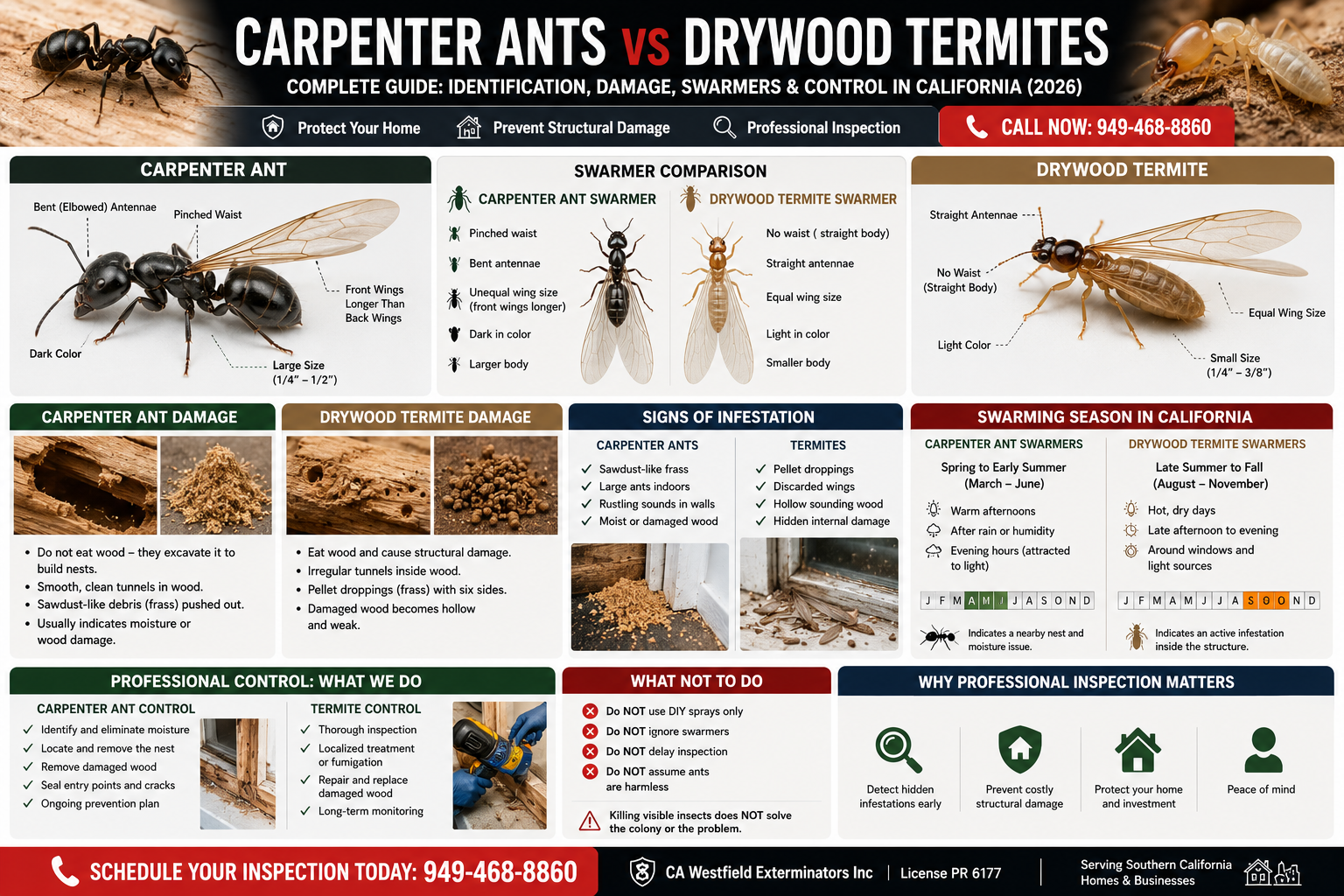
🔍 Key Differences (Quick Identification)
🐜 Carpenter Ant
- Narrow pinched waist
- Bent (elbowed) antennae
- Wings unequal size
- Dark color (black/brown)
- Larger body
🪵 Drywood Termite
- Straight body (no waist)
- Straight antennae
- Wings equal size
- Light / pale color
- Smaller and uniform
🧠 FIELD IDENTIFICATION (PRO LEVEL)
✔ If you see insects flying indoors:
👉 Check:
- Waist shape
- Wing size
- Color
🔥 FAST RULE
Pinched waist = Ant
Straight body = Termite
PART 2 — CARPENTER ANT BEHAVIOR & DAMAGE


✔ Key Behavior
- Do NOT eat wood
- Excavate wood for nesting
- Prefer moist or damaged wood
✔ Damage Pattern
- Smooth, clean tunnels
- Sawdust-like debris (frass)
- Secondary damage (not structural consumption)
⚠️ What They Indicate
👉 Hidden issues:
- Water leaks
- Wood rot
- Ventilation problems
PART 3 — DRYWOOD TERMITE DAMAGE (HIGH RISK)


✔ Key Behavior
- Eat wood continuously
- Live inside wood structures
- Silent damage over time
✔ Damage Pattern
- Irregular tunnels
- Pellet droppings
- Hollow structural wood
⚠️ Structural Risk
👉 HIGH
- Beams
- Framing
- Roof structure
PART 4 — SWARMERS (CRITICAL WARNING)


7
🚨 What Swarmers Mean
🐜 Carpenter Ant Swarmers
- Colony nearby
- Possible moisture issue
🪵 Termite Swarmers
👉 🚨 ACTIVE INFESTATION INSIDE STRUCTURE
PART 5 — SWARMING SEASON IN CALIFORNIA
(Carpenter Ant vs Drywood Termite Timing Guide)
🐜 Carpenter Ant Swarming Season


📅 Typical Season:
👉 Spring to Early Summer (March – June)
✔ Peak Activity:
- Warm afternoons
- After rain or humidity increase
- Evening hours (often attracted to light)
✔ What It Means
👉 If you see carpenter ant swarmers indoors:
- Colony is very close (inside wall or structure)
- Moisture problem likely exists
🪵 Drywood Termite Swarming Season


📅 Typical Season:
👉 Late Summer to Fall (August – November)
✔ Peak Activity:
- Hot, dry days
- Late afternoon to evening
- Around windows and light sources
✔ What It Means
👉 If you see termite swarmers:
🔥 Active infestation is already inside your structure
🔥 SIDE-BY-SIDE TIMING COMPARISON
| Pest | Swarming Season | Risk Meaning |
|---|---|---|
| 🐜 Carpenter Ant | Spring (Mar–Jun) | Nearby nest / moisture issue |
| 🪵 Drywood Termite | Late Summer–Fall (Aug–Nov) | Active structural infestation |
🚨 CRITICAL TIMING INSIGHT (VERY IMPORTANT)
👉 If you see flying insects:
- Spring → likely Carpenter Ants
- Late Summer/Fall → likely Termites
🔥 But DO NOT rely on season alone
Always confirm with:
- Body shape
- Wings
- Antennae
🧠 PROFESSIONAL INSIGHT
👉 In California:
- Termite swarms often happen when homeowners are least expecting (late season)
- Carpenter ants swarm when moisture conditions improve
📞 WHEN TO CALL (IMPORTANT)
👉 Call immediately if:
- Swarmers appear inside your home
- Wings are found near windows
- Swarming happens repeatedly
🔥 CRITICAL INSIGHT
Termite swarmers indoors = Immediate inspection required
PART 6 — SIGNS OF INFESTATION


✔ Carpenter Ant Signs
- Sawdust (frass)
- Large ants indoors
- Wall noises
- Moist wood
✔ Termite Signs
- Pellet droppings
- Discarded wings
- Hollow wood
- Hidden damage
🛠️ PART 7 — PROFESSIONAL TREATMENT STRATEGY


✔ Carpenter Ant Control
- Eliminate moisture
- Remove damaged wood
- Locate nest
- Seal entry
✔ Termite Control
- Full inspection
- Localized treatment
- Fumigation (if severe)
- Monitoring system
🚨 WHAT NOT TO DO
🚫 Do NOT spray randomly
🚫 Do NOT ignore swarmers
🚫 Do NOT delay inspection
🔥 Surface treatment ≠ problem solved
🧠 FINAL EXPERT ANALYSIS
👉 These pests represent two different risks:
🐜 Carpenter Ant
- Indicator pest
- Condition problem
🪵 Termite
- Structural pest
- Damage problem
🔥 FINAL TAKEAWAY
If you see flying insects indoors,
assume inspection is required immediately