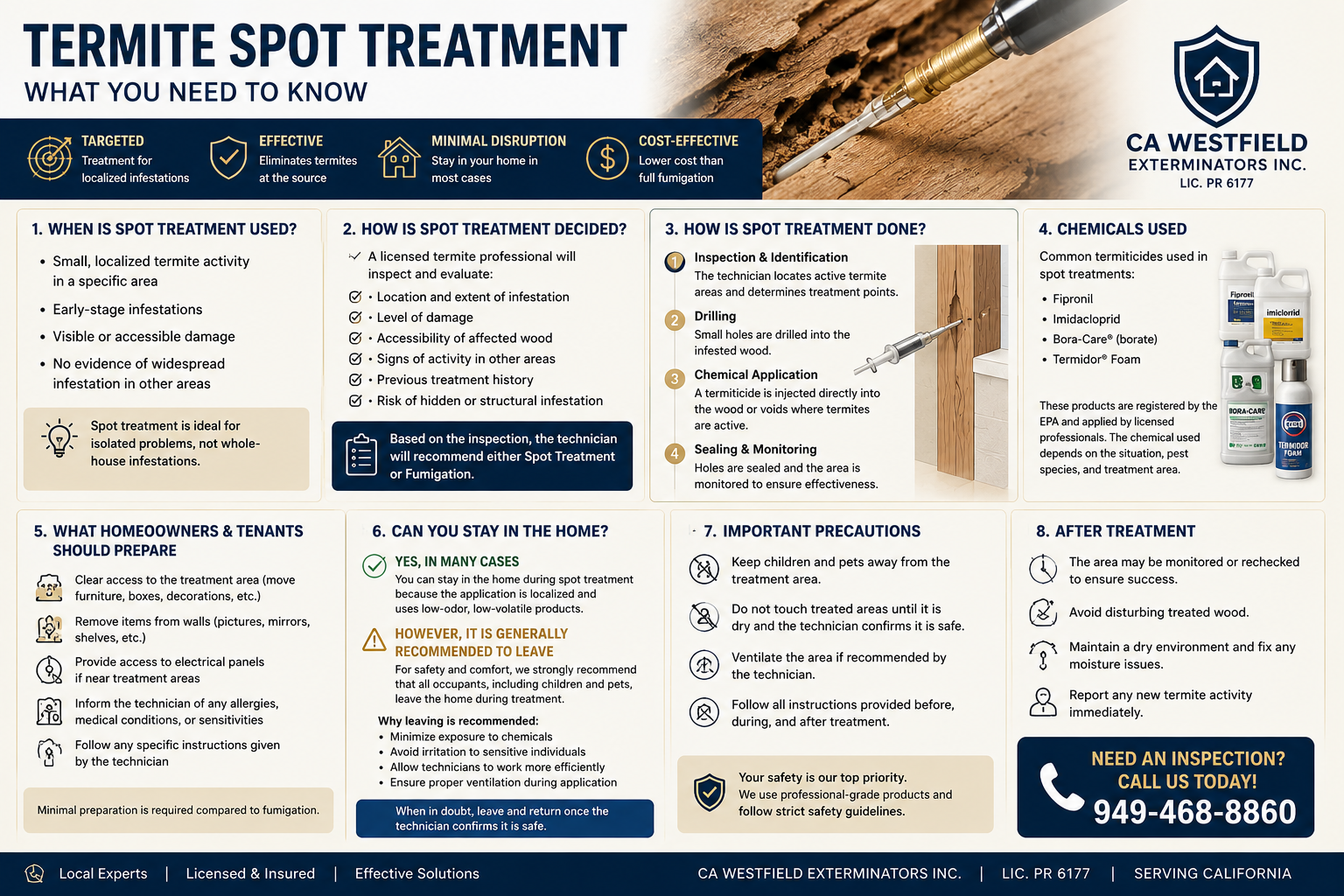
When It Is Used, How It Is Decided & What Homeowners and Tenants Must Prepare (2026)
📞 Schedule a Professional Inspection
CA Westfield Exterminators Inc • License PR 6177
🧠 OVERVIEW
Spot treatment (local treatment) is a targeted termite control method designed to eliminate infestations that are:
- Clearly identified
- Limited in size
- Accessible for direct treatment
🔥 Critical Insight:
Spot treatment is not based on cost —
👉 it is based on accuracy of diagnosis
PART 1 — WHEN SPOT TREATMENT IS USED
✔ Appropriate Situations
Spot treatment is recommended when:
✔ 1. Infestation Is Localized
- Termites are found in a single, isolated area
- Example:
- Window frame
- Door frame
- One wall section
✔ 2. Early Detection
- Damage is minimal
- Activity is newly discovered
- No signs of spread
✔ 3. Direct Access Is Possible
- The technician can:
- Drill into wood
- Inject treatment directly
- Reach the entire affected zone
✔ 4. No Structural-Wide Activity
- No evidence of termites in:
- Attic
- Multiple rooms
- Structural beams
🚨 WHEN SPOT TREATMENT SHOULD NOT BE USED
Spot treatment is NOT recommended when:
- Termites are found in multiple areas
- Damage appears in different rooms
- Previous treatments have failed
- Activity continues after treatment
- Infestation source is unknown
🔥 Professional Rule:
If the infestation cannot be fully mapped → spot treatment is riskyIf the infestation is not localized or appears in multiple areas,
spot treatment may not be effective.👉 In these cases, full-structure fumigation may be required.
Learn more about termite fumigation and preparation here.https://cawestfieldtermite.com/termite-fumigation-preparation-steps-safety-guidelines/
PART 2 — HOW THE DECISION IS MADE
✔ Step 1: Professional Inspection
A licensed inspector evaluates:
🔍 Key Factors
✔ 1. Location Mapping
- Single vs multiple infestation points
✔ 2. Extent of Damage
- Surface-level vs deep structural damage
✔ 3. Activity Status
- Active termites
- Old damage (inactive)
✔ 4. Accessibility
- Can all affected wood be reached?
🧠 Decision Logic (Field Standard)
Localized + visible + accessible → Spot Treatment
Hidden + widespread + unknown → Fumigation
🏡 PART 3 — HOMEOWNER PREPARATION
✔ Before Treatment
🧳 Required Preparation:
- Move furniture away from treatment area
- Clear access to walls and wood surfaces
- Remove fragile or valuable items nearby
✔ Food & Personal Items
👉 Unlike fumigation:
- No full house preparation required
- No need to bag all food
⚠️ However:
- Move food away from treatment zone
- Cover nearby items
- Avoid contamination
✔ Pets & Children
👉 Must be kept away from:
- Treatment area
- Work zone
🏡 PART 4 — CAN YOU STAY IN THE HOME?
✔ Can You Stay in the House During Spot Treatment?
👉 Yes — in many cases, you CAN stay in the home
👉 However:
⚠️ In some situations, you may be advised NOT to stay
🔥 And in most real-world cases, it is strongly recommended to temporarily leave the home
🧠 WHY STAYING IS SOMETIMES ALLOWED
Spot treatment is:
- Localized
- Controlled application
- Limited chemical exposure
👉 Because of this:
- Full evacuation (like fumigation) is NOT required
- Treatment is confined to specific areas
⚠️ WHY LEAVING IS OFTEN RECOMMENDED
👉 Even though staying is technically possible, professionals often recommend leaving because:
✔ 1. Chemical Sensitivity
- Some individuals may react to:
- Odor
- Airborne particles
- Chemical residues
✔ 2. Indoor Air Quality
- Temporary odor may occur
- Ventilation may be limited during application
✔ 3. Children & Pets Risk
- More sensitive to chemicals
- May accidentally access treated areas
✔ 4. Treatment Efficiency
- Technicians can work:
- Faster
- More freely
- Without interruption
✔ 5. Safety Margin (Best Practice)
🔥 Professional Recommendation:
Even if staying is allowed,
👉 leaving the home during treatment provides the highest level of safety
🚨 WHEN YOU SHOULD NOT STAY
👉 You should strongly consider leaving if:
- Treatment involves multiple areas
- Stronger chemicals are used
- You have:
- Children
- Pets
- Elderly occupants
- You are sensitive to odors or chemicals
✔ IF YOU DECIDE TO STAY
👉 Follow these strict guidelines:
✔ Stay Away From Treatment Area
- Do not enter treated zones
- Keep distance until advised
✔ Ventilation
- Open windows if recommended
- Allow airflow after treatment
✔ Protect Pets & Children
- Keep them completely away
- Consider temporary relocation
✔ Follow Technician Instructions
- Every treatment is different
- Always follow site-specific guidance
🧠 REAL FIELD INSIGHT (VERY IMPORTANT)
👉 In real-world situations:
- Most homeowners choose to leave
- It reduces:
- Stress
- Exposure concerns
- Liability issues
🔥 Industry Practice:
“Allowed to stay” ≠ “Recommended to stay”
💡 FINAL TAKEAWAY
You CAN stay,
but leaving is the safer and recommended option
⏱️ PART 5 — HOW LONG IT TAKES
👉 Typical duration:
- 1 to 4 hours
✔ After Treatment
- Area may need drying time
- Surfaces should not be touched immediately
- Normal activity resumes shortly
🏢 PART 6 — TENANT RESPONSIBILITIES
✔ If You Are a Tenant:
- Coordinate with landlord or HOA
- Be present during scheduled time
- Provide access to treatment area
❗ Important:
- No access = no treatment
- Missed appointment = delays
⚠️ PART 7 — COMMON MISTAKES
❗ What Homeowners Often Do Wrong
🚫 Choosing spot treatment for large infestations
🚫 Ignoring small termite signs
🚫 Blocking access to walls
🚫 Not following instructions
🧠 PROFESSIONAL INSIGHT (VERY IMPORTANT)
👉 Most failures occur when:
- Infestation was larger than expected
- Termites were hidden beyond treated area
🔥 Expert Insight:
Spot treatment only works when the infestation is fully understood and contained
💡 FINAL EXPERT CONCLUSION
👉 Spot treatment is:
- Fast
- Convenient
- Cost-effective
👉 BUT:
- Not a complete solution for widespread infestations
🔥 FINAL TAKEAWAY
Correct diagnosis = successful treatment
Wrong choice = recurring termite problem
If the infestation is not localized or appears in multiple areas,
spot treatment may not be effective.
👉 In these cases, full-structure fumigation may be required.
Learn more about termite fumigation and preparation here.https://cawestfieldtermite.com/termite-fumigation-preparation-steps-safety-guidelines/
📞 Need Professional Evaluation?
Choosing the right treatment depends on the size and location of the infestation.
👉 Spot treatment is best for small, localized issues, Long-term Protection
while fumigation is recommended for widespread or hidden infestations.